|
Locating
the Defect
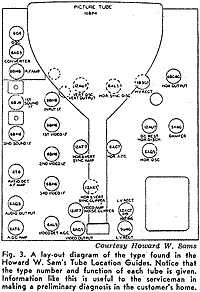
Figure 3 shows a lay-out diagram of the type found in the
Television Tube Location Guides published by the Howard
W. Sams Co., Inc., of Indianapolis 5, Ind. Information regarding
the tube type and the tube function is given on the diagrams,
and this information is often useful to the serviceman.
(In fact, it would be well for you to purchase a set of
these manuals for use on service calls.)
(click to enlarge)
The
lay-out diagram shown in Figure 3 is for the Westinghouse
Model H-207B(DX). Let's check our service technique using
that receiver. In the following discussion of typical troubles,
reference will be made to specific tubes in the set, and
you can check the diagram to locate the particular tube
that is being discussed.
Sound, No Raster. The most frequent reason
for this complaint is failure of the high voltage applied
to the picture tube, and you should always check that possibility
first using a high voltage probe and a voltmeter. If you
find that high voltage is being applied to the picture tube,
it will be necessary that you check the voltages at the
other electrodes of the picture tube. Be sure to note whether
or not the filament of the picture tube lights.
If all of the voltages are correct, check the setting of
the ion trap If the trap is not properly set, no raster
will appear. If adjusting the ion trap does not correct
the complaint, and if all element voltages seem normal,
a new picture
tube should be tried in the set, Since changing a picture
tube is quite a job, the other tests described here should
be made first.
This receiver-like most modern TV receivers -uses the "kick-back"
or "horizontal flyback" type high-voltage supply
that was mentioned previously. Energy produced by the horizontal
retrace is rectified to produce the high voltage that
is needed for the second anode of the picture tube. This
means that the high voltage is dependent upon proper operation
of the horizontal oscillator-amplifier section of the receiver,
and any failure in that section would cause failure of the
high voltage. Therefore, if high voltage Is not available,
your first step will be to determine whether the trouble
is in the highvoltage rectifier circuit or in the horizontal
sweep circuit.
A good way to check the picture tube HV supply is as follows:
Hold a well-insulated screwdriver by the handle so that
the metal blade is approximately one-fourth inch from the
plate lead of the high-voltage rectifier tube. If an arc
is obtained, it indicates that the horizontal oscillator
and the horizontal amplifier are operating and that voltage
is being applied to the highvoltage rectifier. Therefore,
the defective component must be between that point and the
second anode of the picture tube. (Assuming, of course,
that the picture tube is not defective.)
First, try a new high-voltage rectifier tube; if that does
not correct the complaint, check the resistor that is usually
In series with the highvoltage lead, and the high-voltage
filter condenser. Also a gassy picture tube can cause overloading
of the rectifier circuit. This possibility is easy to check
because the gas will cause a blue glow to appear between
the elements in the neck of the tube when the ion trap is
set properly. (A slight blue glow is normal if the ion trap
is mis-adjusted.)
On the other hand, if no arc is obtained at the plate lead
of the high-voltage rectifier, the trouble is in the horizontal
output circuit, the damper circuit, or the horizontal oscillator
circuit. Check each of these tubes by temporarily substituting
new ones.
If temporarily substituting new tubes in those circuits
does not correct the complaint, a circuit component Is defective
and further tests will be necessary.
|




