|
Virtually
all modern receivers have some form of automatic gain control
(commonly abbreviated age.) The purpose of this circuit
is to maintain a constant value of contrast at the picture
tube even though the strength of the received signal may
vary. There is often considerable variation in signal strength
between the channels that can be received in a given area,
and if no age were present, the set would overload on the
strongest signals, and the picture would be very faint on
the weaker signals unless the contrast and brightness controls
were readjusted each time the set was tuned to a different
channel.
The one remaining section of the typical TV receiver is
the low-voltage power supply used to furnish plate voltages
and filament voltages to all of the stages. The power supplies
used are usually quite simple, and some of the latest sets
use selenium rectifiers instead of rectifier tubes. "Brute
force" filtering Is used, and it is unlikely that any
NRI student or graduate would have a great deal of difficulty
locating a defect in this type of circuit.
Analyzing the Complaint
When you are called upon to service a TV receiver, the first
step will be to determine whether or not the set has ever
operated properly. If the set operated properly at one time,
it is logical to assume that some defect in the set causes
the particular condition that the customer describes. If
the set has not operated properly since being installed
and is still within the warranty period, you should recommend
that the customer contact the company from which the set
was purchased. Perhaps there are "bugs" in the
set, or perhaps the installation is at fault. In either
case, the customer will probably prefer to have the work
done by the company that sold the set or by the company
that installed the set.
After you have determined whether the set worked properly
at one time, check the reception on each channel that is
received in the area. It may be that a given complaint occurs
only on the "high" channels, or only on the "low"
channels. Also, the customer's complaint may be an interference
condition that occurs on only one channel. If it is possible,
ask the customer to explain exactly what he finds wrong
with the set, and preferably have the customer operate the
set to show you what is wrong. You should do this so that
you can confirm the customer's actual complaint. You may
be more critical of some things than the customer is, and
he may be more critical of other things than you are. Your
job is to correct the customer's complaint, and then you
can ask about repairing other defects that you may notice.
Finally, on the basis of the set's operation and the customer's
complaint, you should apply the correct technical name to
the trouble, and then proceed with your servicing. The CORRECT
technical name is important because you will want to be
able to describe the complaint to another serviceman if
necessary.
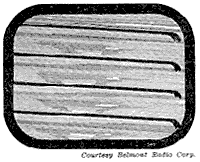
| Fig.
2. Most customers would describe this condition
as "no picture," but the proper term is "picture,
no horizontal sync." |
Correct
Technical Names
If you were discussing a TV service problem with another
technician, he would ask three important questions: Do you
obtain sound? Do you obtain a raster? Do you obtain a picture?
Let's
discuss each of these terms briefly so that you will be
able to give accurate answers.
Do you obtain sound? That is, can the audio
portion of a television program be received and heard? Customers
usually describe this condition correctly.
Do you obtain a raster? That is, does a light
appear on the face of the picture tube, and does the lighted
portion extend over most of the face of the picture tube?
A proper raster depends upon the presence of ample high
voltage, as well as horizontal and vertical sweep signals.
When the tube does not light, the customer will usually
describe the condition as "no picture," but the
technician should always use the term "no raster."
Do you obtain a picture? That is, does picture
information appear on the screen-even though the picture
may be out of sync? Figure 2 shows a picture that is out
of horizontal sync. Most customers would describe this condition
as "no picture," but the serviceman should use
the proper term, "no horizontal sync."
It is important that proper technical terms be used when
writing to NRI regarding a TV service problem. If the correct
terms are not used. the Institute may misunderstand your
problem and not be able to furnish the information that
you need.
Also, some customers are familiar with technical terms,
and they often judge a serviceman by his use of the terms.
That is another important reason why you should always use
the correct expressions in describing a given condition.
|




